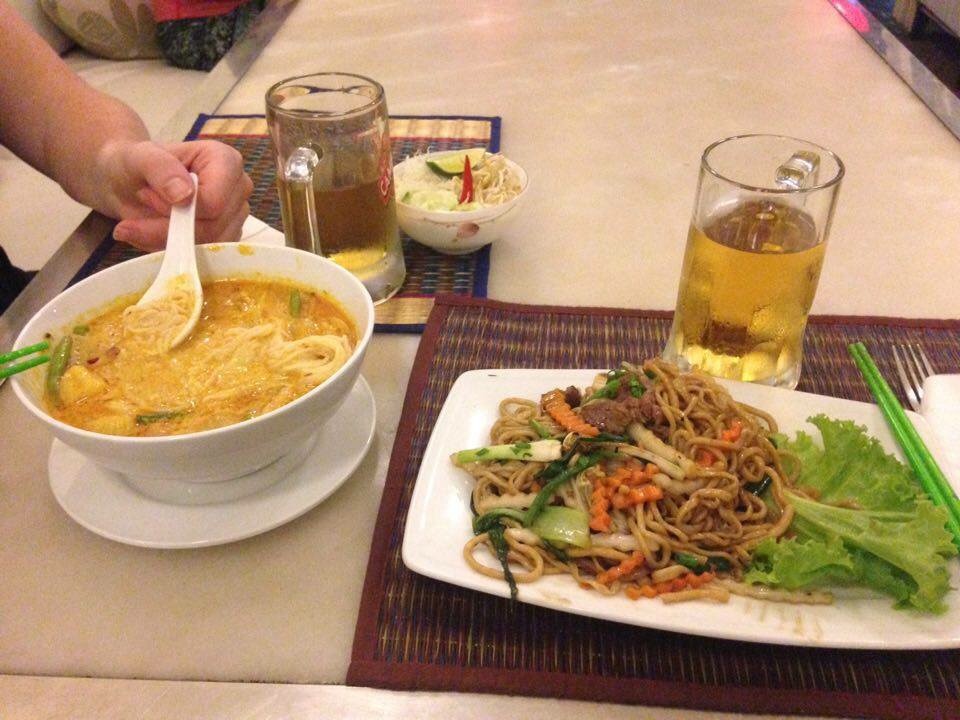
We took a bus from Ho Chi Minh City to get across the border to Cambodia and to our destination of the day, Phnom Penh, the capital of the kingdom of Cambodia. The supposedly 6 hour bus ride became an 8.5 hour ride, our first introduction to “Cambodian time”. It was a little weird crossing a land border into a developing country, as we had to turn our passports in to our bus driver who took them to immigration while we waited in a weird empty warehouse, but everything went fairly smoothly and we got to our hotel before it got too dark. We set out to find some cheap food for dinner, and after pouring through a website of cheap meals in Phnom Penh, we found a noodle restaurant nearby for dinner. It was still more than $10 for our meal, which compared to the prices we had seen in Vietnam, was fairly expensive for what we got. We got a delicious fried noodle dish and a noodle curry of sorts.
The next day we set out to explore a few of the main attractions of Phnom Penh, the Killing Fields and S21. These are both historical sites that were central parts of the genocide committed by the Khmer Rouge in the late 1970s. For those who don’t know the history, I will give a brief overview. This post isn’t for the faint hearted, so if you don’t want to read about/see depressing things, stop here. I have never been, but I would imagine this is similar to going to the concentration camps at Auschwitz.
The American bombing of the Cambodian countryside during the Vietnam war chased many people into the cities for safety, creating chaos and leaving many people with a lack of trust in their crippled government. The growing communist party in Cambodia took this opportunity to recruit and build their party, forming the Khmer Rouge in the late 1960s and eventually capturing Phnom Penh in 1975.
The Khmer Rouge believed in a tough form of communism, and wanted their country to be completely self-sufficient. They closed the borders, schools, banks, hospitals, and nearly every public institution, abolished currency and personal property, and began implementing a classless society: everyone was to become like the “old people”, or simple agricultural workers. They forced people out of the cities by telling them they were only going away for 2 or 3 days because of a threat of American bombing of the city. The people were forced to work on collective farms. They wanted to triple their current rice production, while feeding people a mere tablespoon or two of rice per day, which proved nearly impossible. Many people were forced to work 12 hours non stop per day; many died of starvation and exhaustion working on these farms.
The Khmer Rouge did not want intelligent people in their agricultural society, so anyone perceived to be intelligent, such as teachers, doctors, engineers, people wearing glasses, and anyone that was reported to the regime as intelligent, were rounded up and secretly sent to prisons such as S21. They were tortured and questioned endlessly, and many were forced to write false confessions that they were working for the CIA or KGB. Once a confession was obtained, they were rounded up and sent to the killing fields. All of this was meticulously documented by the Khmer Rouge.
At the killing fields, the people were killed one by one. They did not have many bullets to waste, so many were killed with agricultural tools such as hoes and axes, or even sharp bits of palm leaves. Infants were smashed against a tree. They were thrown into mass graves and covered with chemicals to make sure everyone actually died.
By 1979, the regime became so paranoid that it had killed off many of its members and began to loose power. They were eventually kicked out of power, but not before killing nearly 1/4 of the Cambodian population at the time.
The tours of both the S21 prison and killing fields were depressing but incredibly informative, with audio tours that explained the history leading up to the use of these sites and even included survivor stories. It was a good way to inform visitors of the crimes against humanity that were committed while allowing everyone to process the information in their own bubble.
We went out to the killing fields first, about a 30 minute tuk tuk ride out of the city. This site was particularly difficult to deal with, because many bones and pieces of old clothing have risen to the top of the soil throughout the fields, due to the hasty burials and the Cambodian rainy seasons washing away the dirt around them. The caretakers take the loose bones and clothes and put them in a shrine of sorts several times per year, but many are still partially buried and visible from the walkways. It is still very real.


A pagoda was built to house the skulls and large bones that were discovered when the killing fields were found right after the collapse of the regime.

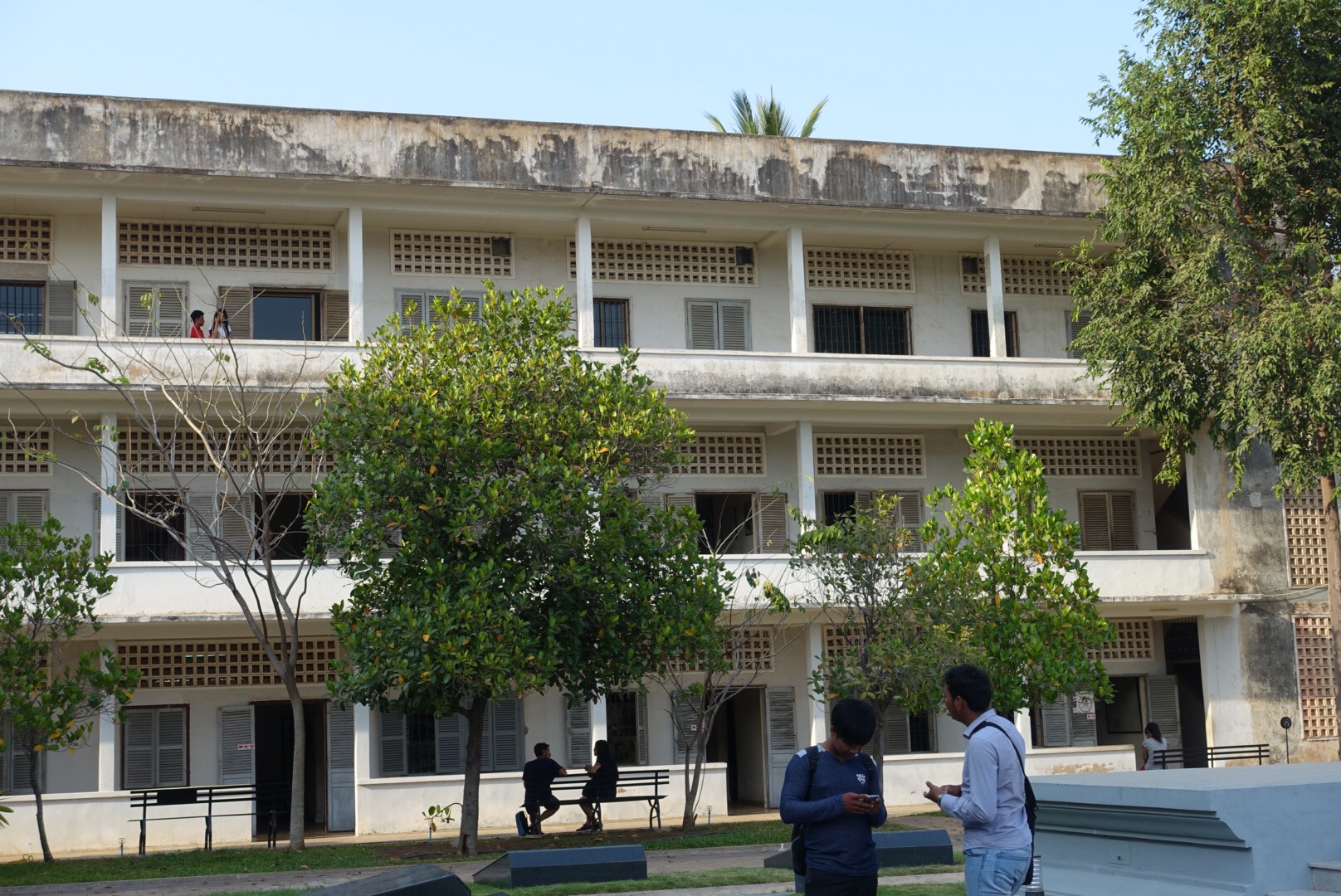
The second half of the day was spent at the prison, S21, which was back in Phnom Penh. It was an old school that was hastily converted into a prison when the regime needed one. I didn’t take many pictures here, I think I had gotten kind of numb by this point.

After a long day of learning about the genocide, we went out for dinner at a nearby Indonesian restaurant before calling it a night. We made plans to leave the next day for a stint of volunteering at CPOC, the Center for Poor and Orphaned Children, which we found through a message sent to us by the owner of the center on workaway.info. But I will have to save that for the next post!
 fromkatietoyou